


Urban Greenspace Shape

Urban greenspaces contribute to a wide variety of benefits – from improving local health outcomes to mitigating the effects of climate change – that help to make our towns and cities liveable places. The quality, accessibility and amount of urban greenspace are regularly used to assess whether the provision of this community asset could be improved. A growing body of research suggests that the shape of a greenspace can be a factor in optimising the potential benefits that it provides and the functions it performs.
This infographic highlights four principles which inform that shape: Context, Core, Complexity, and Connection. These four ‘Cs’ help to understand how shape can make a difference when designing new greenspaces or improving existing ones.
Click on the infographic to enlarge it.
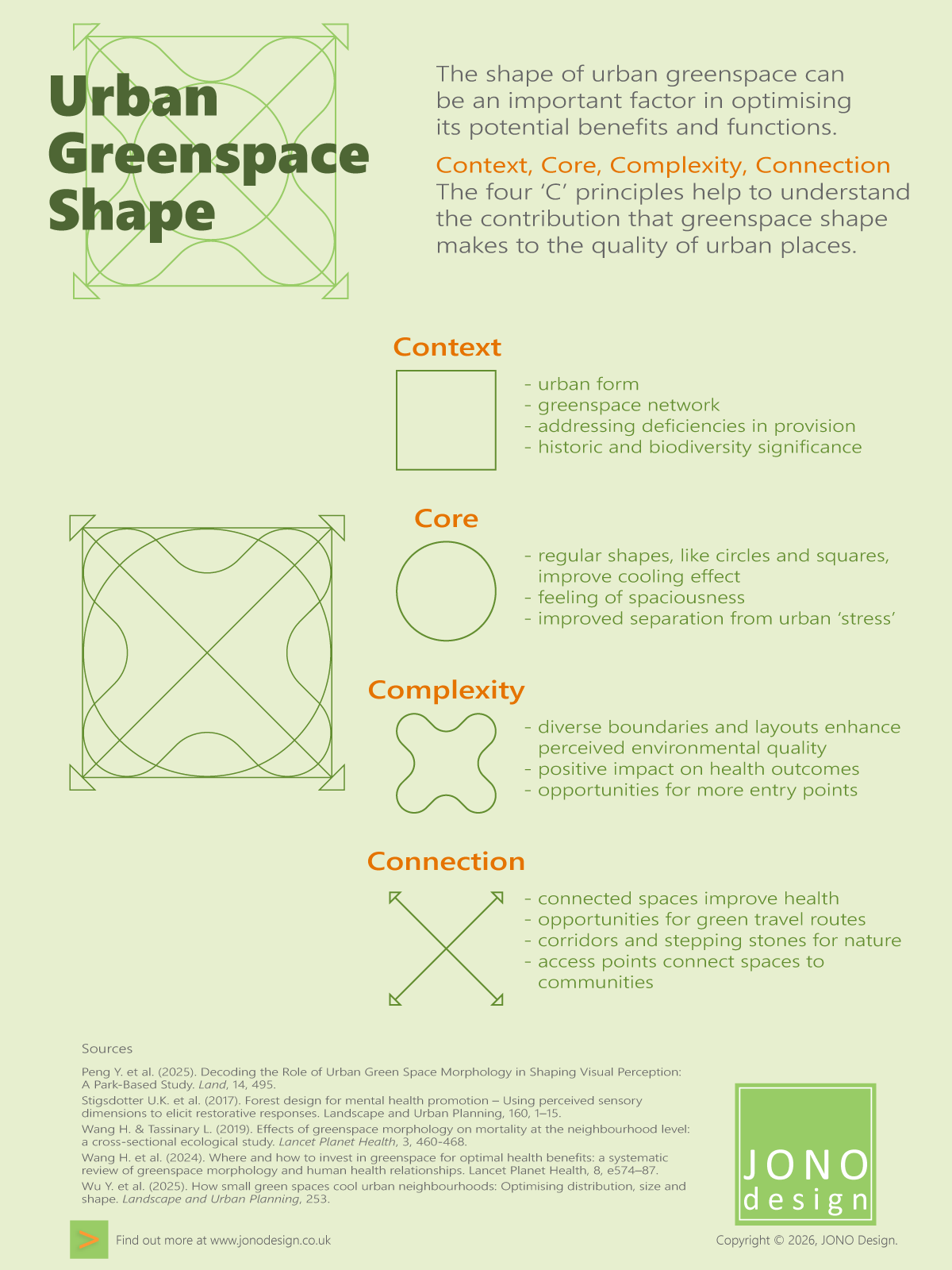
The infographic visualises each of the four principles as a separately shaped element and combines each element into a single motif.
Context
Urban form will have an influence on the shape of a greenspace, imposing restrictions or creating opportunities. How the space integrates into the wider network of greenspaces may determine whether a ‘core area’ is linked by green corridors to other core areas. For example, a network of spaces could be linked to a river feature, with core areas that provide a floodplain function.
Deficiencies in provision that are identified in an Open Space Strategy could be addressed by shaping the greenspace. For example, extending a finger of greenspace from a core area could give communities closer access to public space. Similarly, there could be opportunities to design new spaces to improve nature conservation through green corridors and stepping stones to link together habitats.
Core
Regular shapes, like circles and squares, produce a more pronounced cool island effect that lowers the temperature both in and outside the greenspace. Ensuring that a greenspace contains core areas can help to ameliorate high urban temperatures. Combining the core areas with corridors of greenspace can help to spread the cool island effect into the urban area.
Greenspaces with core areas can help to reduce stress as park users are able to ‘escape’ from the built-up area into a more open and natural landscape. Perimeter buffer zones can reduce noise pollution and enhance the mental health benefits.
Complexity
The complexity of the perimeter of a space , and of the internal landscaping and layout, can enhance the perceived environmental quality of a greenspace. Research has found that a more complex greenspace shape is associated with improved physical and mental health, even reducing the risk of mortality from conditions such as heart and respiratory disease. This association could be due to more positive visual perceptions created by a more dynamic space, and opportunities for more entry points that increase interest and engagement in the open environment.
Connection
Creating and improving the links between greenspaces to create green networks reinforces the physical and mental health benefits by providing green routes and active travel options through more natural surroundings. Green connections between spaces also benefit nature conservation and can provide other green infrastructure functions, such as heat amelioration and flood prevention.
Extending fingers of greenspace into the urban area can improve people’s access by bringing entry points closer to where people live. Linked networks of greenspaces also increase the options available, with different routes and more spaces to visit, and are associated with stimulating interest in and increasing positive perceptions of the greenspace.
Sources
Peng Y. et al. (2025). Decoding the Role of Urban Green Space Morphology in Shaping Visual Perception: A Park-Based Study. Land, 14, 495.
Stigsdotter U.K. et al. (2017). Forest design for mental health promotion – Using perceived sensory dimensions to elicit restorative responses. Landscape and Urban Planning, 160, 1-15.
Wang H. & Tassinary L. (2019). Effects of greenspace morphology on mortality at the neighbourhood level: a cross-sectional ecological study. Lancet Planet Health, 3, 460-468.
Wang H. et al. (2024). Where and how to invest in greenspace for optimal health benefits: a systematic review of greenspace morphology and human health relationships. Lancet Planet Health, 8, e574-87.
Wu Y. et al. (2025). How small green spaces cool urban neighbourhoods: Optimising distribution, size and shape. Landscape and Urban Planning, 253.
This infographic appeared in JONO Design e-news. The e-news is published once every couple of months and each issue contains a specially designed infographic.
Click on the orange button to sign up for JONO Design e-news.

Get in touch to discuss your design requirements
or to request a quote.

enquiries@jonodesign.co.uk

Copyright © 2015-2026 JONO Design.
Designing solutions with Word