


Urban Blue Space

Water – such as rivers, canals, lakes and coastlines – can feature prominently in urban environments. Often, the associations with urban water are negative, being linked to the risk of flooding and pollution. While these risks need to be managed and mitigated, ‘Urban Blue Spaces’ are increasingly being recognised for their contribution to ecological balance and for enhancing urban living.
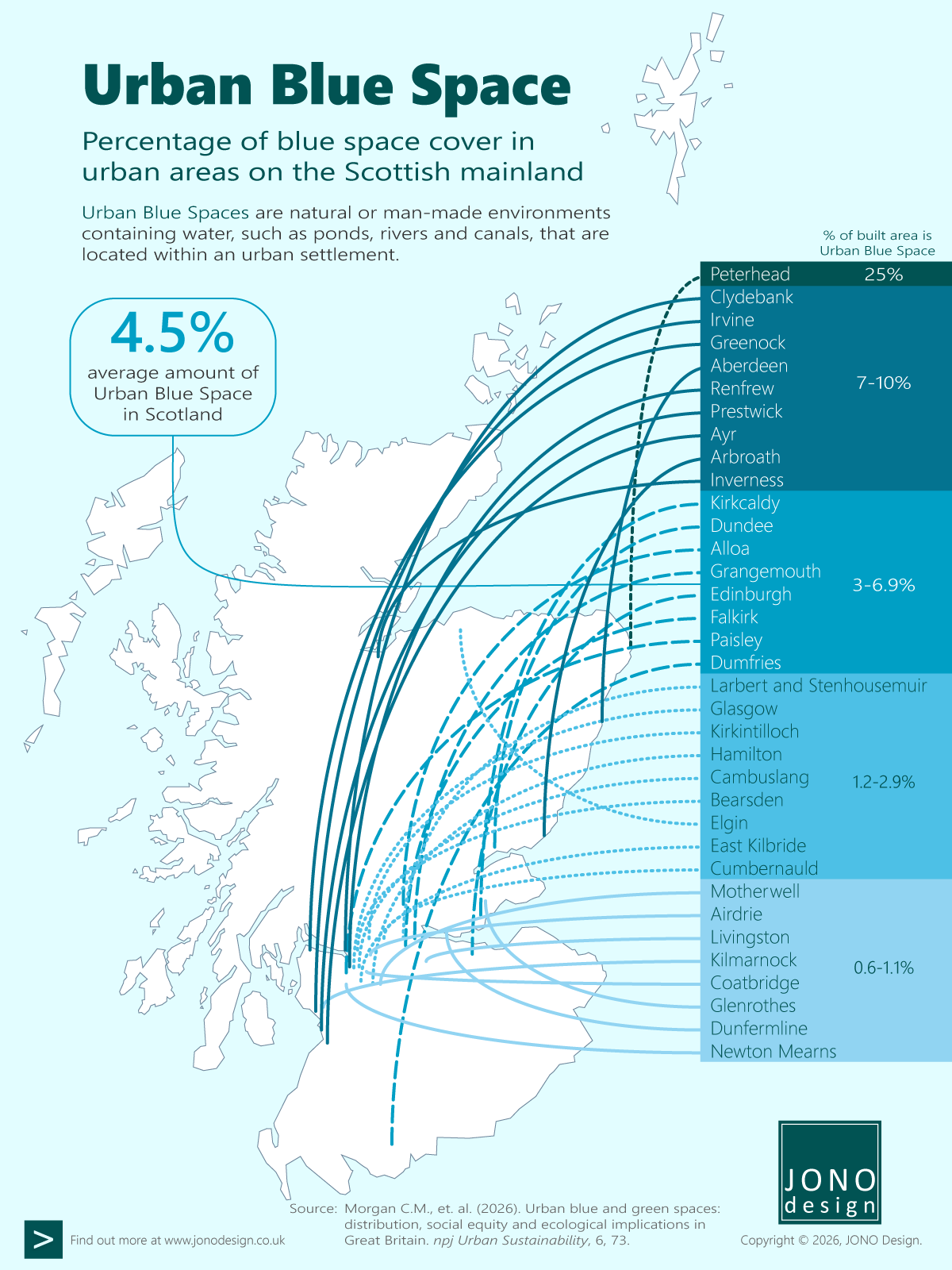
Better integration of water into the design of our outdoor urban environment will benefit local communities and the health of our environment. This infographic illustrates the amount of Urban Blue Space in urban settlements on the Scottish mainland.
Click on the infographic to enlarge it.
What is Urban Blue Space?
Urban Blue Space refers to water features, both natural and man-made, that are found in the urban environment. Natural features include rivers, lakes, coastlines and ponds, while man-made features include canals and shore fronts. Blue spaces form part of the overall provision of open space types in the urban environment. Such types include green space, grey space (or hard surfaced areas such as roads), green infrastructure and linear space.
Benefits
Access to blue space has been shown to have a positive impact on physical health and mental well-being. Waterways can act as a gateway to physical activities such as walking, swimming and canoeing. Meanwhile, research has found that access to blue space is linked to reducing stress and anxiety, and can also promote social interactions.
Further benefits are economic: well-maintained blue space can enhance the attractiveness of places, boosting property values and making areas more desirable as places to visit or to which to locate for work.
Blue spaces form an important part of the environmental infrastructure of urban areas, supporting biodiversity and ecological health. This network of blue and green spaces also helps to adapt and mitigate the effects of climate change, through cooling and managing water levels.
Provision of Urban Blue Space in Scotland
A recent research project measured the amount of blue space in around 500 urban settlements in the UK (Morgan et al., 2026). The infographic demonstrates the amount of Urban Blue Space in 35 towns and cities on the Scottish mainland that were included in the study. The infographic ranks the 35 urban areas by the percentage of land covered by Urban Blue Space. The average amount of Urban Blue Space in Scotland is 4.5%.
Peterhead, in north east Scotland, has by far the largest amount of Urban Blue Space on the Scottish mainland, with blue space accounting for 25% of land cover in the town. Peterhead is also Britain’s busiest fishing port, so it is perhaps not surprising that the town scores so highly, being built around a large harbour bay.
The remaining 34 settlements have been grouped together into quartiles (four roughly equal sets), each quartile shown in a different shade of blue. The darker the shade, the larger amount of blue space in the urban area. The spatial distribution of the quartile groups on the infographic reveals that those areas with the most Urban Blue Space are found in the west of central Scotland, and along the coast of north east Scotland.
Sources
Gascon M., et al. (2017). Outdoor blue spaces, human health and well-being: A systematic review of quantitative studies. International Journal of Hygiene and Environmental Health, 220(8), 1207-1221.
Georgiou M., et al. (2021). Mechanisms of Impact of Blue Spaces on Human Health: A Systematic Literature Review and Meta-Analysis. International Journal of Environmental Research and Public Health, 18(5), 2486.
Morgan C.M., et al. (2026). Urban blue and green spaces: distribution, social equity and ecological implications in Great Britain. npj Urban Sustainability, 6, 73.
Völker S. & Kistemann T. (2011). The impact of blue space on human health and well-being – Salutogenetic health effects of inland surface waters: A review. International Journal of Hygiene and Environmental Health, 214(6), 449-460.
This infographic appeared in JONO Design e-news. The e-news is published once every couple of months and each issue contains a specially designed infographic.
Click on the orange button to sign up for JONO Design e-news.

Get in touch to discuss your design requirements
or to request a quote.

enquiries@jonodesign.co.uk

Copyright © 2015-2026 JONO Design.
Designing solutions with Word