


The Shetland Bus

2025 marks the 80th anniversary of the end of World War II, with VE Day, or Victory in Europe Day, commemorated on the 8th of May. Norway was occupied by the Germans near the start of the war, in 1940. Many Norwegians, including soldiers, sailors and airmen, escaped to Britain to continue the fight for a free Norway. Others stayed in Norway, setting up resistance networks.
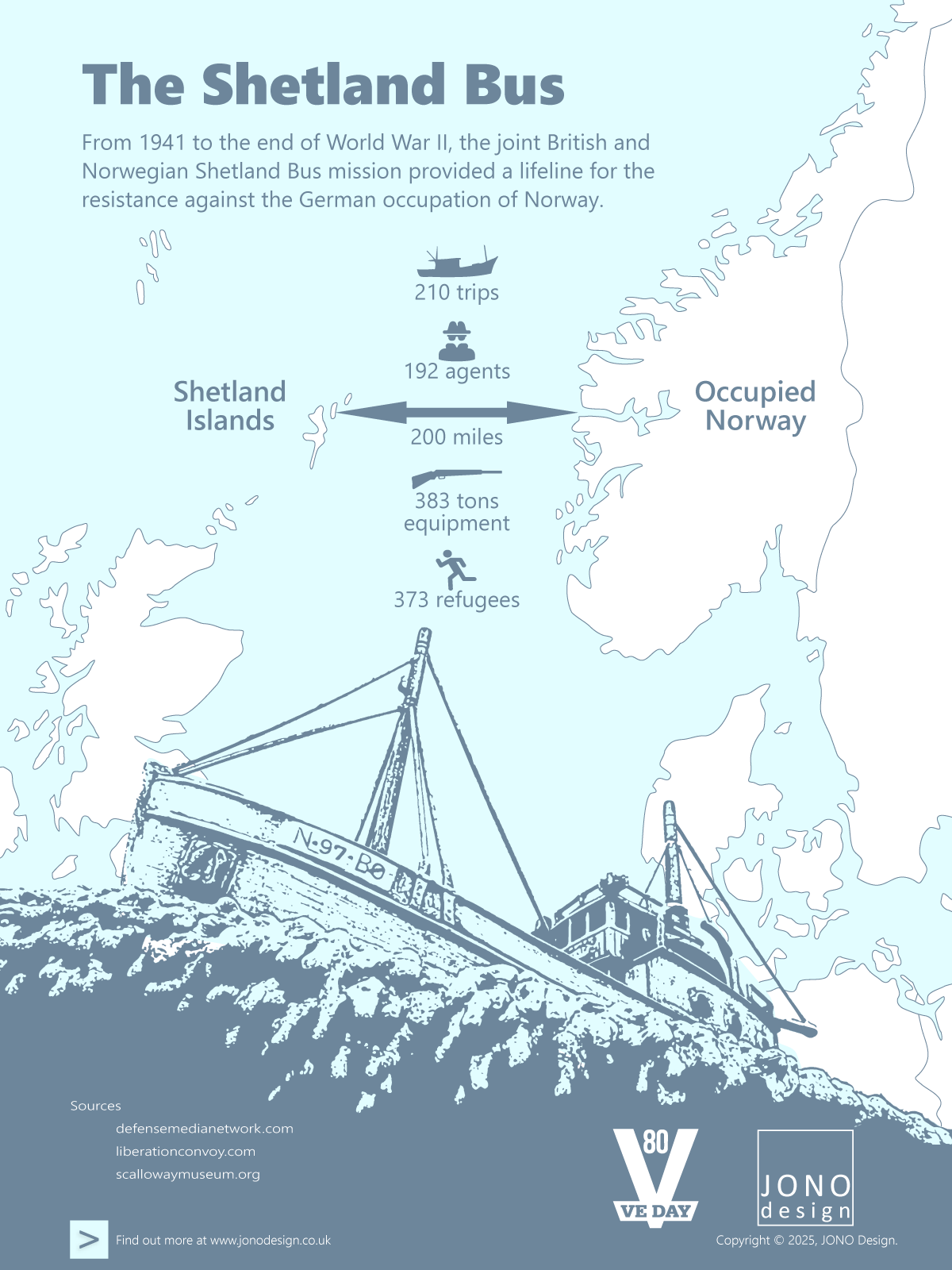
A joint British and Norwegian mission was organised with the aims of transporting agents to and from Norway and the Shetland Islands, supporting the resistance groups, and rescuing people who were facing arrest. This infographic highlights the endeavours of the mission, which became known as the Shetland Bus.
Click on the infographic to enlarge it.
The boats
The Shetland Bus was established in the Shetland Islands in August 1941. In the first few years, Norwegian fishing boats, manned by Norwegian fishermen and sailor volunteers, were used to cross the 200 miles of the North Sea from Shetland to the Norwegian coast. From 1943, small fast naval motorboats replaced the fishing boats.
The boats provided the Norwegians with a link to the outside world, as well as a lifeline that supported the resistance against the German occupation, and an escape route for those in danger.
Operations
To undertake the operations, the boats had to traverse the often treacherous North Sea, as well as avoid contact with German patrols.
Agents, mainly Norwegians, were trained in Britain and then transported via the Shetland Bus from Shetland, to land clandestinely in Norway. The agents would make contact with local resistance groups and gather information on economic and military targets, as well as sabotage enemy communications and installations. Information would then be sent back to Britain via the Shetland Bus.
Over two hundred trips were made between 1941 and the end of the war in 1945. Over this period, forty-four men died and ten fishing boats were lost. The ‘bus’ made 210 trips that transported 192 agents, 383 tons of equipment (including weapons, radios and supplies), and rescued 373 Norwegians across the North Sea.
Memorial
The infographic has been designed using a photo of the monument in Scalloway, Shetland, that commemorates the operations and names all those who lost their lives. The monument consists of a small metal sculpture of one of the fishing boats that braved the route, and dramatically illustrates the heavy seas that these small boats had to sail through.
Sources
defensemedianetwork.com
liberationconvoy.com
scallowaymuseum.org
This infographic appeared in JONO Design e-news. The e-news is published once every couple of months and each issue contains a specially designed infographic.
Click on the orange button to sign up for JONO Design e-news.

Get in touch to discuss your design requirements
or to request a quote.

enquiries@jonodesign.co.uk

Copyright © 2015-2026 JONO Design.
Designing solutions with Word